

Studying Italian in Italy can help many adults learn faster, but only if they can still use Italian after they leave class. The best thing about learning “on the ground” isn’t the view outside the classroom. It’s the everyday, small things you do all day: ordering lunch, sorting a SIM card, asking a question at reception, hearing the same phrases often enough that they stop feeling new.
Most disappointments don’t come from lack of effort, but rather from poor setup. The common problems are easy to spot: an Italian course that doesn’t fit your goals, a place to stay where English is the main language, and afternoons that slowly turn into familiar habits.
This guide will help you prepare for your Italian language course in Italy. It will help you choose the right course, schedule and living arrangement to help you learn the Italian language and make sure that you go home with stronger language skills.
What should I know before I study Italian in Italy?
Start with one clear goal (speaking confidence, an exam…). Then choose a city, the intensity of the course and the type of accommodation. When you contact Italian schools, ask about: group work, real speaking time, how teacher feedback works, what do you need to do if feel like you ended up in the wrong level. Finally, plan a week where Italian is necessary, not just “nice to have” (for example, choose to stay with an Italian family rather than a house with other foreign students).

Who this guide is for
This is for adults who want to learn Italian in a focused, mature way and who don’t want to waste time or money.
This will suit you if you:
- Set a clear goal (for example, speaking confidently, preparing for an exam, work, university, or “life + progress”).
- Need a plan (Don’t just hope for the best!)
- Focus on teaching quality (provide useful feedback, not just friendly vibes).
- Want to learn language by using it, not just by knowing its grammar.
If you’re planning to stay for a while or have legal/visa requirements, think of the admin section as general planning. The rules are different for each country and they are always changing, so it’s always best to check with official sources.
What is the best way to learn Italian in Italy as an adult?
Build a weekly routine that is sustainable for you. Make sure the level and class format are right, and that you have a daily routine that includes speaking Italian as well. Also, choose a living setup (such as a homestay or shared accommodation) that makes using English less convenient. Intensity helps, but only if you can keep it up.
Before you book, it’s important to understand what ‘immersion’ actually means
Immersion is more than just being in Italy. It’s what happens when Italian becomes the easiest option:
- You hear the same language in places like bars, shops, reception areas and classrooms.
- You practise speaking a little bit every day, even when it feels awkward.
- You receive feedback regularly; this will help you improve.
- Your routine makes speaking your native language the exception, not the norm.
If you study in the morning and then spend the rest of your day without practicing Italian, progress is slower. It’s not that you’re doing it wrong; it’s just that your environment isn’t helping.
Here’s an example (the English bubble):
Emma books an intensive course in a busy area and shares a flat with students from other countries. After class, everyone uses English because it’s easy and fun. Two weeks later, she can explain grammar rules, but still gets nervous when ordering coffee. The solution isn’t to “try harder”. It’s changing one practical thing: a homestay/host family, Italian flatmates, or repeating the same routines that make Italian unavoidable.
Make sure to plan your afternoons and evenings before you leave. Class helps, but it’s only part of the week.

First, choose your goal. This will change your destination, course and budget
“Learn Italian” is too vague for a real plan. Pick one main objective first, and then think about what could help you achieve it.
1) Speaking with confidence
Make sure you spend time talking and correcting mistakes. You want a class that helps you improve your speaking skills, not one where you mostly listen and fill in worksheets.
2) Passing an exam (CILS/CELI)
Look for practice exercises that are like the real exam. These might include writing tasks, speaking tasks, mock tests and timed exercises. Ask how the school tracks progress and whether the programme fits your schedule.
3) Italian for work
You need to practise your skills in different situations, like on calls, in meetings, and via email. You can also practise your skills by role-playing. Knowing the words isn’t enough; you must practise using them in Italian.
4) University or in academic life
You’ll need to have a clear structure, practice your writing, and be sure that your goals are clear. Ask how the course will help you with academic skills (like formal writing, understanding what you read, and making presentations). Find out what level you can expect to reach by the time you finish the course.
5) Life experience plus real progress
Make a weekly schedule that you can actually stick to. If you have a busy social life, that’s great, but if you spend all your time socialising and don’t practise Italian, you won’t improve.
A common problem:
Daniel wants to speak confidently, but he chooses a course that’s mostly grammar worksheets. He feels like he gets a lot done in class, but he struggles with real conversations outside of class because he hasn’t had many chances to practice speaking in front of people. A better fit would be structured speaking lessons, plus a few 1:1 lessons focused on feedback.
Before you book, make sure that you’ve thought about this: ‘By the end of my stay, I want to be able to…’
The five things that will affect your results
Imagine your programme is made up of five sliders. If you move them deliberately, you’ll get better results.
1) Course intensity
If you study only a few hours a week, Italy can still be a great experience, but progress may feel slower than you hoped. Many adults do well with an intensive rhythm as long as it matches their energy and life commitments.
Here’s an easy way to decide:
- If you are staying for 2-3 weeks, it is often better to do more intense training (as you will have less time to build momentum).
- If you want to stay for 8-12 weeks, it’s a good idea to build strong routines outside class. This will help you keep up the steady pace.
A short timeline example:
Liza has one week between jobs. She has a busy schedule and always goes to the same places: the same café, supermarket and bus stop. It might sound small, but practising makes you learn faster: you start to understand what is being said, and it doesn’t feel as scary to speak.
If you’re short on time, it’s often better to go more intensive for fewer weeks than to stretch light lessons across a longer period without a system.
2) Speaking time and feedback (this is the most important part, but most people don’t pay attention to it)
Two intensive courses can feel totally different. The difference is often:
- How much does each student talk in class?
- How do teachers correct mistakes?
- Is the feedback constructive (and not just “good job”)?
Ask for simple, direct answers, not pleasing jargon. It’s great to meet friendly people, but it’s also important to have a way to improve your skills.
3) Your longest lesson of the day is in your accommodation
Accommodation isn’t just about comfort; it’s about exposure too
Which is better: a homestay (with a host family) or a shared flat?
A homestay/host family can provide steady listening and everyday Italian, depending on how much you actually interact at home. Italian flatmates can be great, but they’re not always good conversation partners. International flatmates are sociable and fun, but English is often the language used unless you set rules.
Here are some options:
- Homestay/host family: you will learn to listen every day, as well as real-life vocabulary and cultural rhythm.
- Shared flat with students from other countries: it’s easy to make friends, but English often seems to be the main language used.
4) City environment
How do I choose the best city to study Italian in Italy?
Pick a city for your weekday routine, not your weekend fantasy. In places where there are a lot of tourists, it’s easier to find someone who speaks other languages. In smaller cities, Italian is often the only language people use, which can help shyer people. Your habits are still the most important thing.
If your school is in a place that isn’t visited by many tourists, that can be a real advantage. For example, studying in places like Como can help you avoid relying too much on speaking English as a common language. Similarly, cities like Verona offer a good balance: international enough to feel comfortable, but local enough that Italian is still the default language in daily life, especially once you move beyond the main tourist areas. If you like modern, lively southern cities, Catania is a good choice. It’s a vibrant place with lots of culture and great food, but it’s important to find your own routine there.
Which Italian city is best for avoiding the English bubble?
There isn’t one best city. Choose a place where people live and work in Italian: local cafés, neighbourhood shops, activities with locals. Then plan your week so you can really use Italian.
5) The time of year (how much energy it takes, how much it costs, things that get in the way)
Busy times can be exciting but they can also be distracting (there are crowds, it’s hot and there is pressure on where you will stay). Quieter periods often make routines easier. Choose a season that helps you focus, not just a season that feels good. Our Italian courses at Team Lingue run all year long in all of our locations.

Find your best setup in 2 minutes!
Use this table to help you prioritise. Don’t try to make everything perfect, choose one main goal.
| Priority | City type that tends to help | Course setup that fits | Accommodation that supports Italian | Biggest risk |
|---|---|---|---|---|
| Speak confidently fast | Smaller/medium city | Intensive + speaking practice | Homestay/host family or Italian flatmates | Avoiding speaking until you feel “ready” |
| Exam preparation (CILS/CELI) | Any | Exam prep + writing/oral tasks | Quiet setup, predictable week | Underestimating writing + timed tasks |
| Italian for work | Medium city | Intensive + targeted 1:1 | Flexible + practice opportunities | Learning vocab without practising tasks |
| Culture + progress | Medium city | Balanced intensity | Mixed, but with language rules | Social life replacing practice |
| Budget-focused | Smaller city | Group course | Shared flat + language plan | Saving money but living in English |
If you want everything, pick your top priority and let the rest support it. It’s the best way to make quick decisions.
Which is better: group lessons or one-to-one lessons, and when?
There is no single best format. There are different levels and styles to choose from, so you can find the one that best suits you.
Beginners (A1–A2)
Group classes can help you learn better, because they provide structure and repetition. If you add anything, add guided speaking lessons.
Intermediate (B1)
Many adults find that they can’t learn any more words in B1. What helps is more speaking, better correction, and practising outside class so it doesn’t feel scary.
A typical B1 plateau:
Tom is at the beginner level and feels stuck. The tutor spots three common mistakes (using connectors, choosing the wrong tense, and pronunciation). With some specific feedback and daily speaking exercises, improvements are visible in just a few weeks. This is not because he’s learning more, but because he manages to fix what’s blocking him.
Upper intermediate/advanced (B2+)
Progress becomes precision: small details, speed, accuracy, writing and how you say things. 1:1 can be extremely helpful here.
If you can only add one extra thing, add a small amount of 1:1 focused on recurring errors and pronunciation. It often helps people understand things better and feel more confident when they speak.
Want to know how to choose a school like a pro? (It’s a question most people forget to ask)
A good school doesn’t just promise a friendly atmosphere. It can explain how learning happens.
Look for a school where:
- The placement process includes an in-person speaking test.
- If you like small groups, it’s important to know how big your class will be.
- The teaching method involves getting students to do some talking as well as listening.
- There is a way to keep track of how you’re doing and change the level if you need to.
- You receive useful corrections (not constant interruption or absence of feedback).
What should I ask an Italian language school before I book?
Ask how they assess levels (written + speaking), the average class size, how much speaking time students get, how correction works, what happens if your level is wrong, and what conversation practice there is outside class. Ask for the weekly schedule and whether they offer online lessons to help you keep up.
Send questions to schools by copying and pasting them into an email
Hello, I’m considering studying Italian with you in Italy. Could you please confirm:
- How do you put students into levels for writing and speaking?
- What is the average class size, and what is the maximum?
- In a normal lesson, how much time does each student get to speak?
- How do teachers point out mistakes? For example, during speaking, after activities or in written feedback.
- What should I do if my level feels too easy or too difficult after the first day?
- Do you offer any other types of sessions to help with conversation or guided speaking, as well as the standard course?
- What is the typical weekly schedule (start time, end time, breaks)?
- Are the materials included? If not, what should I buy?
- Do you keep track of progress (checking every week, feedback at the end of each level, tests)?
- Do you offer online lessons before or after the course to help students keep up?
- Can you recommend places to stay that help people learn the language (like living with a host family or Italian flatmates)?
- Are there any special offers for longer bookings or certain weeks?
If a school gives a vague answer like “Don’t worry, you’ll improve”, that tells you something about the school too.
What should I do if my class level is too easy or too hard?
Speak up on day one or two. Ask for a quick review. A good school should have a clear way to move you on without any problems.
The problem with the English bubble and how to avoid it without making life hard for people
Most learners don’t fail because they’re bad at languages. They stall because English often becomes the default language abroad.
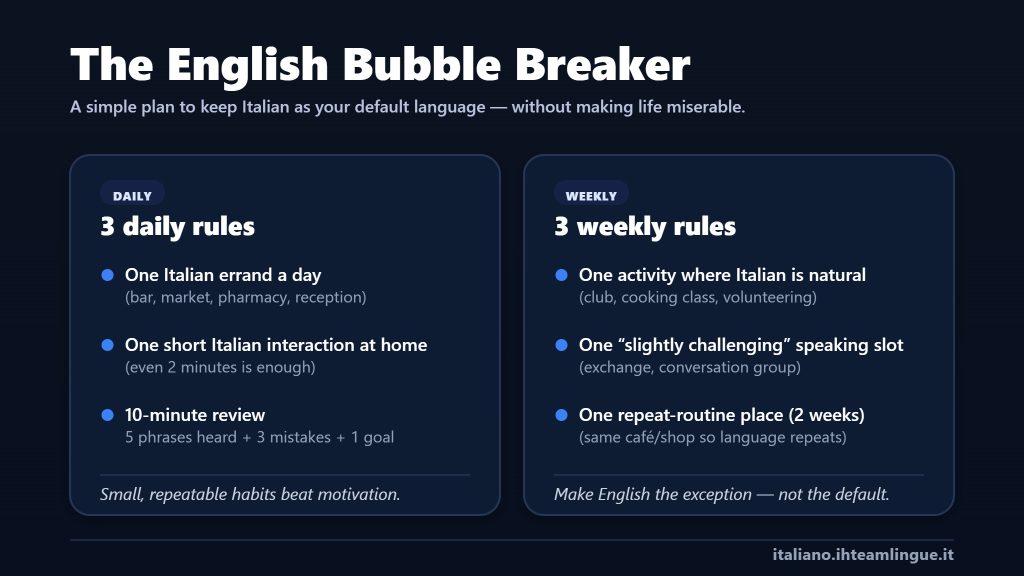
The English Bubble Breaker plan
There are three rules to follow every day
- One errand a day (like going to the bar, market or pharmacy, or to reception).
- Try speaking to your family in Italian for a few minutes.
- Ten-minute review: remember the five things you heard, the three mistakes you made and your one goal for tomorrow.
There are three rules that you must follow every week
- One activity where Italian is natural: going to a club, cooking class, volunteering or going on a guided tour in Italian.
- One speaking situation that’s slightly challenging (language exchange, conversation group).
- Do the same thing at the same place (the same café or shop) for the first two weeks.
Keep it small. The important thing is to form good habits, not to have a perfect plan that you give up on after a week.
Why do Italians switch to English and what should I say?
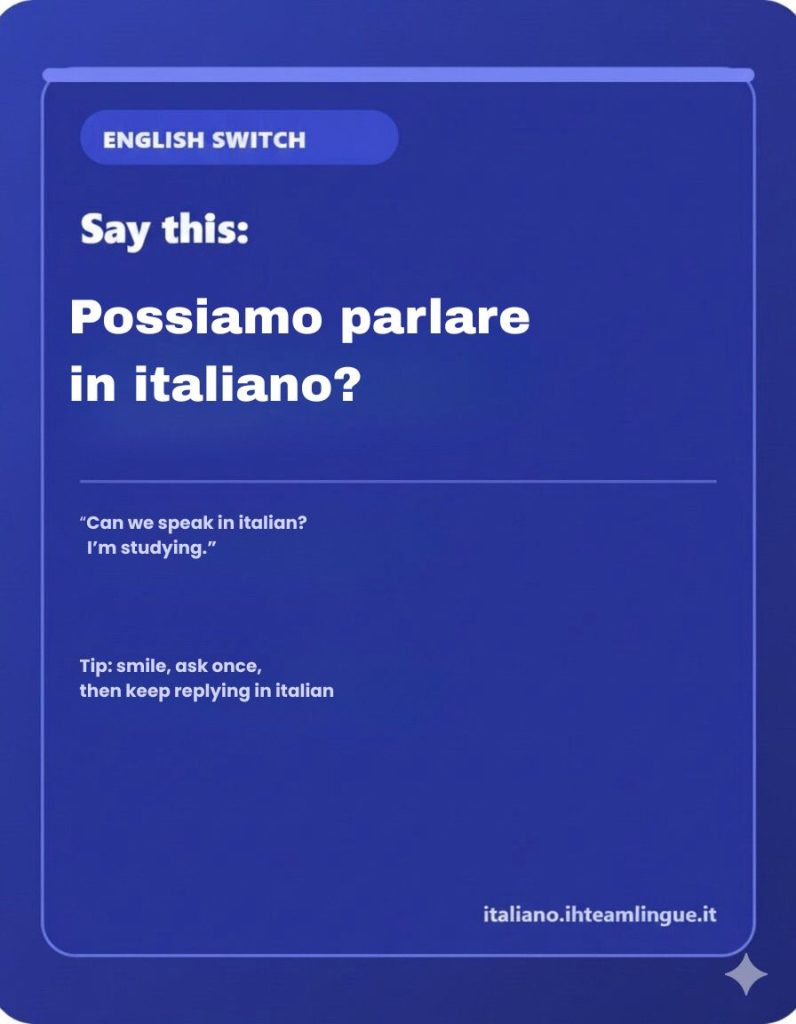
They are usually just trying to be helpful, they don’t want to judge you. Be friendly and keep going:
- “Can we do it in Italian? I’m studying.”
- “I’d like to continue in Italian, please, even if I make mistakes.”
- “Slowly, if you can. I’m learning.”
A timeline that’s realistic and doesn’t make any promises
Progress isn’t a straight line. You’ll have good days and bad days. That’s normal.
Many learners go through phases like:
- Week 1: learn survival language and get used to constant input.
- Week 2: you will be able to understand familiar situations more quickly.
- Weeks 3-4: most adults find that they can speak more smoothly. If you keep giving and receiving feedback and practising, you will get better.
A useful way to measure this is to check about how often you can do day-to-day tasks without switching to English or native language. This often gets better before your grammar feels perfect.
Save these six phrases and use at least one today. They stop you from worrying about what to say
1. English switch
When someone starts speaking English, ask them something, smile, and then keep talking to them in Italian.
2. Too fast
Use this to slow the conversation down without stopping it completely.

3. Vocab help
Use this when you’re missing one word. Then say the new word in a full sentence.

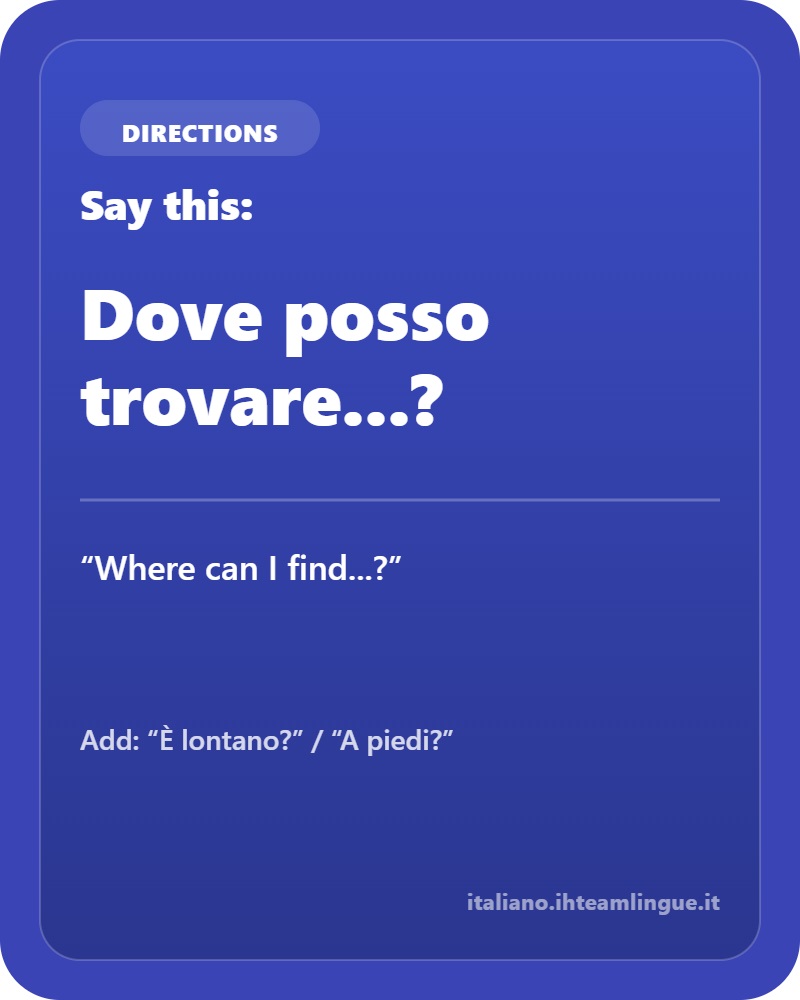
4. Directions
Use this phrase when you’re out and about and need to find something (e.g. shops, services, directions).
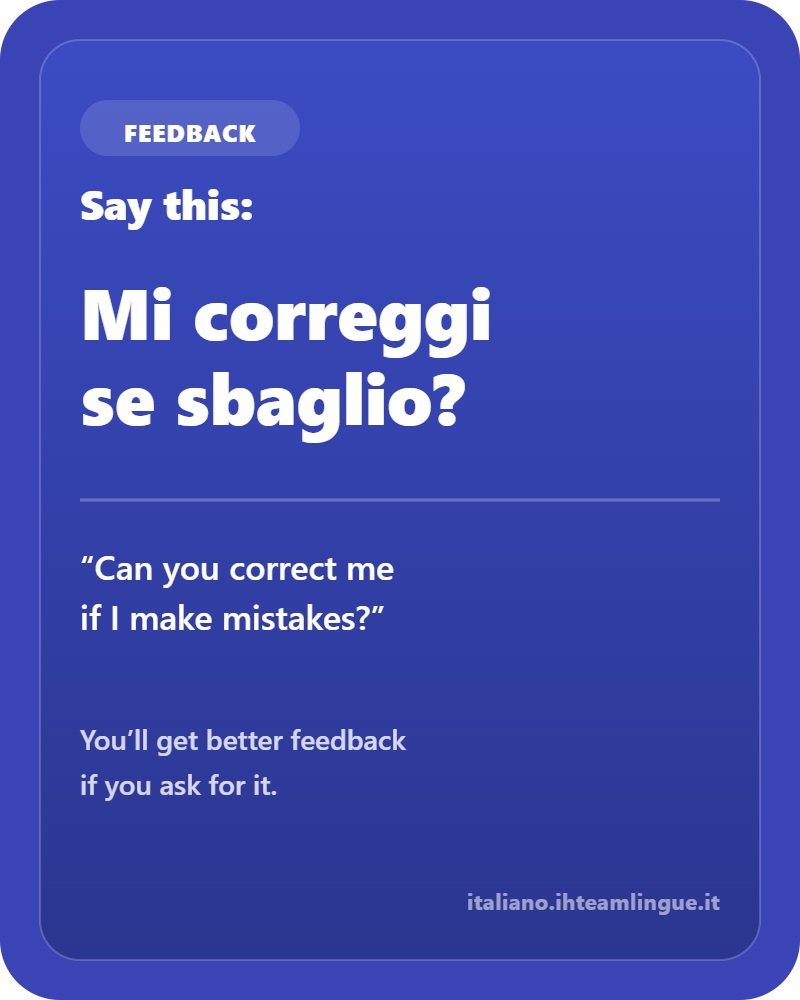
5. Feedback
Try using this to turn casual conversation into a short lesson. You’ll get better feedback if you ask.
6. I didn’t understand
Use this instead of switching to English; follow it with one specific question.

Plan your budget carefully so you don’t get any nasty surprises or unexpected costs
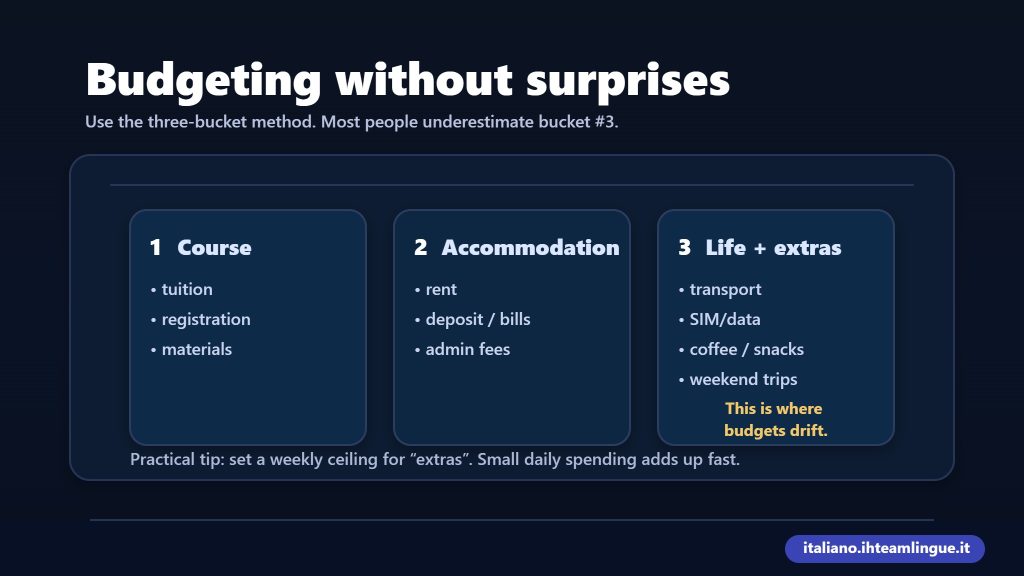
Prices vary a lot depending on the city, the season and your lifestyle, so it’s difficult to give you a single price. If you divide your budget into three parts, you can avoid that big shock.
The three-bucket method
- The course costs money, as does registration and buying materials.
- The price includes the room and the bills/deposit.
- Life + extras (transport, SIM/data, coffee culture, the odd trip)
Many people don’t think bucket 3 is important because it’s a small amount of money. But it can quickly add up to a large sum.
Invisible-cost checklist
- deposits and admin fees
- local transport passes
- SIM card/data
- frequent small spending (coffee, snacks, aperitivo)
- weekend trips
- health coverage requirements (depending on your situation)
Admin essentials: the stuff that can quietly derail your plan
You don’t need to obsess over admin. You just need to respect it enough that it doesn’t steal your first week.
Safe principles:
- if you’re staying longer than a short trip, plan admin time into your first week
- keep digital copies of key documents
- sort basics early: SIM card, transport, banking access
If you need information about legal or time-related matters (e.g. visa rules, residency, exam dates), please check with the relevant official sources or your school.
Things to do before you fly: the week before you leave
A smooth first week often starts before you arrive.
Learning prep
- Decide your main goal (speaking / exam / work / university / mixed).
- Write 10 situations you must handle (bar, supermarket, directions, school admin).
- Learn a small starter set of phrases for those situations (not hundreds).
- Plan your daily routine outside class (where you’ll practise speaking).
- If possible, do 1-2 online lessons before you travel to reduce first-week overwhelm.
Practical prep
- Confirm accommodation details, check-in rules, and host expectations if you choose a homestay.
- Plan connectivity (SIM plan, emergency contacts).
- Pack for reality (comfortable shoes, notebook, adapters).
- Keep bookings, insurance details and school contacts in one folder.
Mindset prep
- Decide now: you will speak Italian even when it feels awkward.
- Expect mistakes, they’re your raw material for progress.
FAQs
How do I choose the length of my stay?
The right length depends on your goal, your starting level, and how much time and energy you can dedicate to Italian each week. One week works best as a focused boost or immersion experience. Two to four weeks are ideal for building confidence and establishing daily speaking routines. Longer stays (eight weeks or more) allow habits to settle, accuracy to improve, and progress to feel more stable – especially for speaking and listening. In general, consistency matters more than length: a shorter stay with strong routines often leads to better results than a longer stay without them. listening.
Is an intensive course always better?
Not always. Intensive training can help many adults, but if you find it is too much, a steadier pace can work — as long as you keep practising every day.
What’s the smartest way to combine group lessons and one-to-one lessons without spending too much money?
Group lessons can help you to learn in a structured way and keep up with other students. Use 1:1 for bottlenecks, which means things like pronunciation, mistakes that keep happening, confidence and exam tasks. Keep your message targeted.
How can I tell if a placement process is reliable?
A placement that includes a speaking tests (as well as written) is usually better. We, at Team Lingue, organize a pre-departure online oral interview for a more accurate placement of students in our class levels. Ask how quickly they can move you if the level is wrong.
How do I know if the class is too easy or too hard?
It’s too easy: you rarely make mistakes and feel like you can’t be beaten. It’s too hard: you can’t take part and you’ll feel lost most of the time.
Is a homestay worth it?
It’s great for listening every day and for getting into a foreign language. It works best when you interact with it at home. If you need lots of privacy, set boundaries early or choose another option.
What if my flatmates only speak English?
Make some simple language rules at home and get used to using Italian in different situations.
Why do Italians answer in English when I speak Italian?
Usually they do it because they want to help or enjoy interacting in a foreign language. Ask politely to continue in Italian and keep responding in Italian.
How can I keep improving at B1?
Speak more loudly and clearly. Add targeted correction and one weekly speaking situation that is slightly harder. Plateaus respond to feedback loops, not endless grammar rules.
Should I choose a city that a lot of tourists visit, or should I avoid it?
Touristy cities can work, but you need to have stricter routines to avoid relying on English. If you find it hard to resist temptation, a place that isn’t as popular among tourists might be better.
What should I do if I feel stuck after the first week?
Don’t worry. Make one change: give specific feedback, let people speak more, or set up a routine that they can repeat. If you make a few small changes, they can quickly add up.
What can I do to keep improving after I get back home?
Leave with a system that works for you. This could be one weekly speaking slot, one consistent input habit (like listening to a podcast or reading) and one small writing habit. Team Lingue also offers online classes that you can follow once you go back home.
Final advice: build a system, not a fantasy
Italy offers extraordinary language input: voices, rhythm, real conversations, history, art, and everyday culture, even in small daily moments (and yes, sometimes over great food). But results don’t come from the country alone. They come from your system: a course that matches your language goals, feedback that turns mistakes into progress, an environment that makes Italian the default language, routines you can repeat every week.
If you’re choosing between two setups, chatting with our staff can be genuinely helpful. A small decision now can save you weeks of “fun trip, slow progress”.