

When choosing where to learn Italian in Italy for adults, it’s important to look beyond just the beauty of the location. For most older students, it’s about picking a place where the workload feels manageable: you get to Italian lessons without any problems, you have enough energy to focus, and you actually practise in real situations so your Italian improves every day.
We help adults who want to study Italian in Italy at their own speed. This is for everyone from people who have just started learning Italian to people who want to use it for work, travel, confidence or to speak it fluently. The pattern we see is always the same: the “best” city isn’t always the most famous one. It’s the place that matches both your language goals and your lifestyle.
Before comparing cities, make a list of the things that are important to you. These could be things like how much you like to walk, how much sleep you need, if you are sensitive to heat, and your budget. People decide where to study Italian more based on these things than on monuments.
Start by creating a profile for your adult learner
Most mistakes people make when planning a holiday happen when they hope their Italian language journey will “happen around it”. Adults usually find it easier to learn and live if they choose a destination that matches how they learn and live.
Think about it in three layers:
- Your language goals. Do you want to get better at speaking, listening and speaking confidently? Or do you need to learn the basics? Different goals mean you will reach different destinations and follow different courses.
- The speed and difficulty of the course. Some adults do really well with an intensive course. Some people find that a semi-intensive course or a standard course works better for them. With these, there is enough free time to practise naturally (and recover properly).
- Comfort profile. Things like heat, noise and busy areas can make it hard to focus. Adults don’t “fail to learn Italian”; they get tired, overwhelmed, and stop practising.
If you can’t describe your typical Monday-to-Friday routine in a few short sentences, you’re not quite ready to choose a destination yet.
Big city, mid-size city, or small town?
This first decision shapes everything: accommodation, noise, transportation, and how easily you slip into English.
1. Big cities
Big cities can be great for motivation: museums, events, international life, lots of choice. They can also make it easier to stay in your English bubble.
If you choose a big city, do this: build a routine that forces repetition. Same neighbourhood, same café, same market, same route to school. Repeated interactions are what turn “Italian in Italy” into real language skills.
2. Mid-size, walkable bases
For many adults, this is the sweet spot. Logistics are easier, and you become a “regular” somewhere more quickly, which helps you practise communication without feeling like you’re “performing Italian”.
3. Smaller bases
Smaller places can feel calmer and more sustainable for mature students who value sleep and low sensory load. The trade-off is that social life often needs structure.
If you’re shy, do this: choose a smaller base, but commit to school activities early so you don’t end up isolated.
Choose the destination category (big / medium / small) first. Then compare specific places.

The six things that really matter when choosing the right place to go
1. Talking opportunities compared to the English bubble.
Touristy doesn’t automatically mean “bad”. The risk is that you might use English when you’re tired.
If you know you’ll hide in English, do this: set one “Italian-only task” every day (ordering lunch, buying something at a market, asking a follow-up question). This is how adults learn new words and become more confident.
This is also why learning in real life feels different to learning with apps: real life gives your Italian purpose and consequences.
If you want to know more about the difference between these two types of Italian language learning, check out the article Why Learning Italian in Italy Beats Language Apps. If you want ready-to-use language to support those daily tasks, it helps to keep a small set of go-to expressions. Our guide Essential Italian phrases: your gateway to interactive learning is a good companion piece.
2. How easy it is to walk and how much it costs to do that every day.
If your day is too complicated, you won’t practise as much. If walking makes you feel good, choose a place where you can walk, and think of your shoes as part of your learning strategy.
If walking makes you tired, choose accommodation close to school and practise in short, easy interactions instead of long sightseeing days.
Your “best destination” is the one that helps you feel calm.
3. The truth about where to stay
Where you go is also where you live. Things like how long it takes to get to school, noise, and laundry all matter.
If you need to be able to concentrate, choose a street that is quieter and ask about noise levels. If you’re travelling alone, make it easy on yourself. When you’re choosing, always go for “easy mornings” over “more space”.
4. Managing climate and energy
Italy in summer is wonderful, but it can be tiring. Heat affects sleep, concentration, and how brave you feel speaking. If you get too hot easily, choose a place where it is cooler (morning lessons, slower afternoons, early evenings).
If you love heat and outdoor life, a Mediterranean rhythm may suit you, but remember that classrooms often use air conditioning.
If Sicily is of interest, you might like to read “Studying Italian in Sicily: here’s why this region is the perfect choice” to get an idea of what the lifestyle would be like. If you’re looking for some handy tips to help you learn Italian quickly, especially if you’re just starting out, then check out ‘How to learn Italian quickly: practical tips for studying in Sicily’ – it’s a great resource!
Pick a place where you can relax and unwind between lessons and real-life practice.
5. Get the right fit for the class
Free time and learning go together. Adults keep learning languages if they enjoy the lifestyle that goes with it.
Some people want art and history. Others want food, markets and daily life – the things that make Italy famous around the world. Some people want to go to the countryside or to the coast.
Choose somewhere you really want to go after class. That’s the best place to use Italian without worrying too much. If you’re staying in Catania, ‘What to do in the evening in Catania’ is a great place to start if you need ideas for things to do after school.
6. How much money do you have available?
Stress about money can also lead to stress about learning. If you’re always thinking about what you’re going to eat and how you’re going to get around, it’s harder to relax and enjoy yourself. Choose a destination where you can afford to travel for more than just the first two days.
Pick your destination in just 2 minutes

This will help you to narrow your choice before comparing specific cities, weeks and programmes.
| Your priority as an adult learner | Best destination type | Why it works | Watch out for |
|---|---|---|---|
| Variety + museums + big-city energy | Big city base | Motivation stays high | Cost, distractions, English bubble |
| Routine + easy logistics | Walkable mid-size base | Repeat interactions build confidence | Can feel quiet if you expect nightlife |
| Calm + sleep + low sensory load | Smaller base | Better recovery supports progress | Social life needs structure |
| Summer outdoor rhythm | Southern/Mediterranean base | Daily life invites speaking | Midday energy dip, air-con contrast |
| Quick progress in short time | Any, with structure | Course intensity + routine drive outcomes | Fatigue if you over-schedule |
If you’re not sure, choose the option that will make your weekdays more enjoyable. The right destination makes things easier. That’s what makes an “ideal language course” feel achievable.
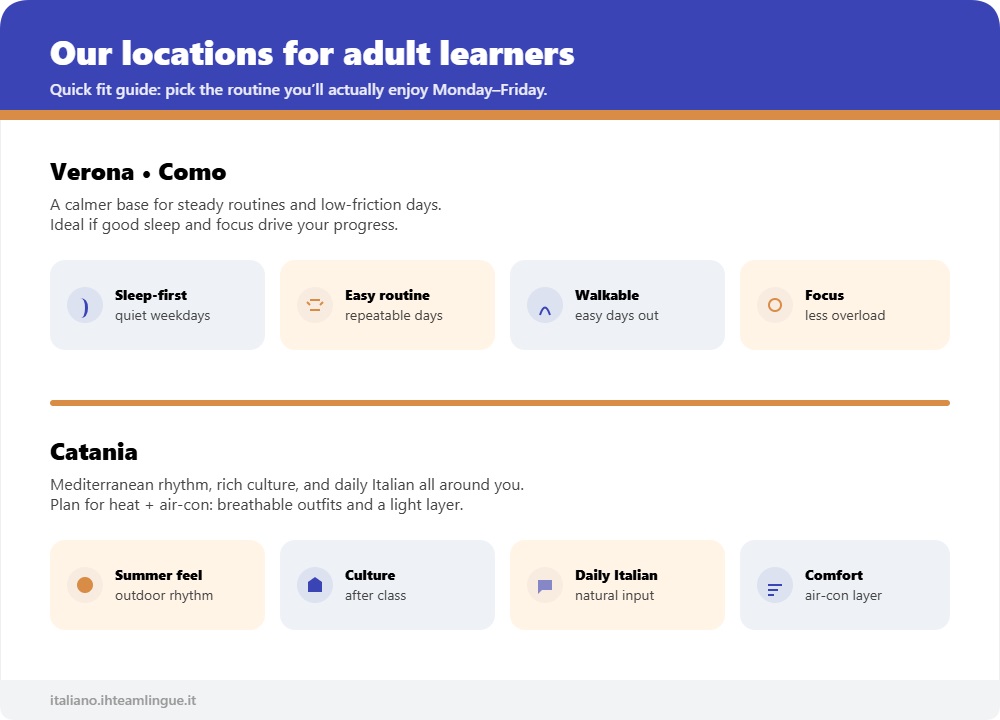
We have different locations, and they are all good for adult learners.
At International House Team Lingue, we offer Italian language courses in different locations. Each location is designed to suit different types of adults.
- Verona and Como are often a good choice for adults who want a calmer base, steady routines, and a relaxed pace, especially for mature students who value good sleep and days without much stress.
- Catania is perfect for adults who want a summer feel with a Mediterranean vibe, rich culture, and a relaxed daily rhythm, while still keeping practical comfort in mind (like air-conditioned classrooms and warm streets).
The programme is similar in all of our destinations: there are organised Italian lessons, lots of speaking practice, and a learning experience that helps you make real progress.
If you let us know what level you’re at, when you want to travel and what you want to focus on (whether that’s culture, preparing for exams or learning the language), our team can help you choose the right place and the best course format. We’ll give you free advice and support to make planning easy. Get in touch.
Choose the right format for the destination and course style

You can’t choose the destination without also choosing the course style. Adults often get better results by first deciding how intense their course will be, and then choosing the best place to support it.
1. Standard course
A standard course is good if you want a balanced day. You have lessons in the morning, then in the afternoon you have real-life practice, culture, and rest.
2. Intensive course
If you don’t have much time but still want to get ahead, an intensive course can be perfect. Just make sure you take enough time to rest and recover. Afternoon sightseeing trips and intensive lessons can make you tired.
3. Semi intensive course
A course that is half-intensive is good for adults who want to learn a lot, but still have free time for things like shopping and going out.
4. Smaller group learning
If you’re nervous about speaking, ask about smaller group courses or formats that encourage participation without pressure.
5. Private lessons and specialised options
If you have a particular goal in mind, you can ask about private lessons or a specialised Italian course:
- Business Italian course for workplace needs and business communication (emails, meetings, professional tone).
- Exam preparation courses if you need a recognised outcome.
Make sure the destination matches the format that protects your energy. Adults progress faster when they can keep up with their routine.
Things to think about when choosing a school
Just copy and paste this into an email. It helps you compare different partner schools and locations (whether it’s a week in Florence, Naples, or a quieter base like Como, Verona, and Catania).
Course and teaching
- What is the timetable, and when do courses begin (do they start every Monday)?
- What’s the typical class size and age mix for adults?
- Are instructors qualified and experienced instructors, and what training supports school quality teaching?
- Is there a clear teaching approach in a dynamic and engaging setting?
Placement and progression
- How does the placement test work, and can we change level after day one?
- Do you offer exam preparation courses?
- Are there exam preparation courses or exam preparation options on our dates?
Course options
- Can we choose between standard, semi intensive course, and intensive course formats?
- Do you offer minigroup Italian course, smaller group learning, or private lessons?
- Do you offer business Italian course options or specialised Italian (for example, business communication)?
Support and logistics
- How far is accommodation from school?
- What’s the laundry situation and noise situation?
- What support is available through the customer service team before arrival?
Value and clarity
- What is included in the programme (lessons, materials, activities)?
- Do you offer any “best price guarantee” policy, or price-matching terms (if relevant)?
Ask questions that show what the school is like and how well the teachers are, not just the city name. If you need a useful reference point before you email schools, What mistakes do foreigners make when learning Italian? is worth a quick read.
If you feel like your destination is wrong, change your routine first
Sometimes the destination isn’t the problem; it’s the daily routine. If you’re an adult student, a few small changes can make the whole experience easier and help you practise your Italian more naturally.
1. Big city overload
Make your radius smaller. Pick one area where you live, and stick with it. Keep taking the same route to school, going to the same café and using the same supermarket. This means that you will have more energy to speak Italian, and repeat interactions will be easier.
2. Quiet but lonely
It’s important to build a social structure early on. Take part in the first school activity and accept the first invitations, even if you feel slightly tired. When you have a routine for lunch or when you meet with a small group, speaking practice becomes part of the day.
3. Air-conditioned classrooms
Make sure you have a light layer in your day bag every day. An overshirt or a soft scarf is usually enough.
It’s an easy way to protect your concentration during lessons.
4. English keeps taking over
Try doing one small “Italian-only” task every day. For example, order coffee and ask a question, buy something at the market, or ask for directions. It’s more important to be consistent than to have big, brave moments. This is how important words are remembered.
5. Long commutes
Make the journey easier. It’s better to take a simple route, especially on busy mornings.
If you can, changing where you are staying can make the whole week feel less stressful.
6. Too much intensity
Balance the workload over the week. Try to keep calm during the week and save the bigger trips for the weekend. Adults often improve more quickly when they have consistent energy levels rather than energy that goes up and down a lot.
If a destination doesn’t work, it’s usually because the routine needs to be changed. Make the days easier, and the learning experience improves quickly.
Pick a place that helps you learn and live at the same time
If you want to learn Italian as an adult, the best place to do it is in Italy. You can make sure that you go to lessons regularly, you learn useful words in the real world and you experience Italy’s unique culture without getting too tired.
Once you’ve chosen where you want to go, the practical planning becomes easier, especially for summer. Our guide, A complete packing list for your study Italian in Italy summer trip, will help you plan what to pack for your trip. It includes things like shoes, layers, things you will need in the classroom and day-bag essentials. You won’t need to pack too much.
If you need help choosing the right location and course format (standard, semi-intensive, intensive, minigroup, private lessons, business Italian, or exam preparation), please get in touch with us.
We will help you choose the best option for your language goals and lifestyle, so your Italian language journey will feel easy from day one.
FAQs
Is it better to choose a less touristy place to learn Italian faster?
Sometimes. The bigger factor is whether you have repeatable speaking opportunities and a routine you’ll stick to.
Should we avoid destinations with strong dialects?
Not necessarily. You learn standard Italian in class. Local speech becomes listening practice and you can still build confidence through repeated interactions.
How long is “long enough” to feel progress as an adult?
Two weeks can shift confidence, especially in speaking. Longer stays help vocabulary and habits stick.
Is a homestay always best for complete immersion?
It can be, but immersion depends on interaction. Many adults prefer independence plus school activities to create daily speaking moments.
Do we need nightlife to make international friends?
No. Many friendships form at lunch, during activities, and on excursions.
If we’re over 50, should we choose differently?
Often, yes: prioritise comfort, walkability, and good sleep. Progress usually follows energy.
Is it worth coming as an absolute beginner?
Yes, with the right support and the right class environment. Beginners often improve quickly once routine settles.
How do we choose between standard, semi intensive, and intensive formats?
Choose the format that matches your energy. Intensive works best when you protect rest and don’t over-plan afternoons.
Do we need private lessons to progress?
Not always. Small groups can work brilliantly. Private lessons are best when you have specific goals or limited time.
What if we have exam anxiety but need an exam?
Choose exam preparation courses with clear structure and realistic practice and ask how the school supports learners emotionally as well as academically.
Is business Italian different from general Italian?
Yes. A business Italian course should focus on business communication tasks, tone, and workplace vocabulary, not just grammar drills.
What’s the biggest destination mistake adults make?
Choosing based on a fantasy itinerary instead of a weekday routine they can actually sustain.