
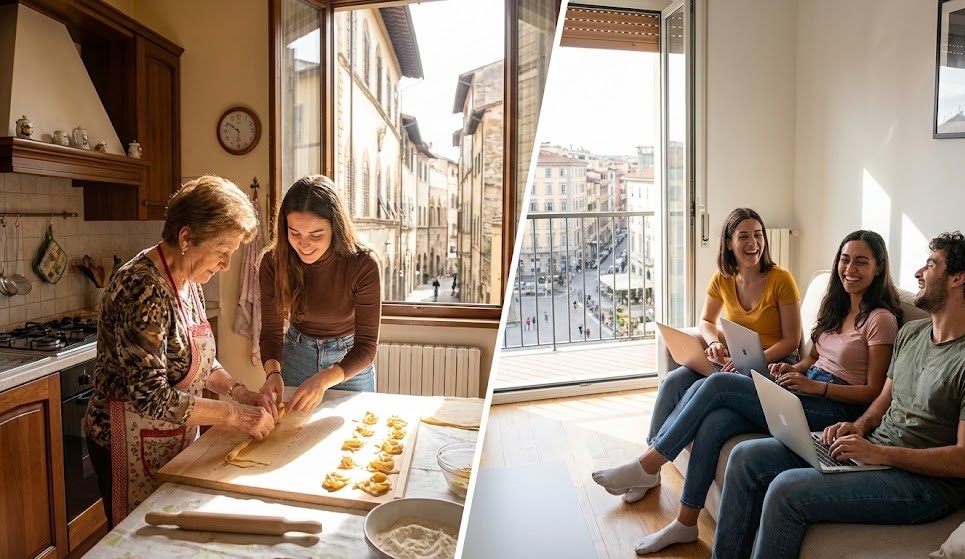
Choosing between a homestay and an apartment for learning Italian in Italy isn’t really about bedsheets or kitchen space. It’s about how much real Italian you’ll hear, speak, and live every single day. Your accommodation can either immerse you in the Italian language right away, or quietly keep you in a comfortable bubble where you study it but never really use it.
Below you’ll find an honest guide: what a homestay is like in day-to-day life (rules, meals, routine), whether an apartment makes you feel isolated, what option is actually cheaper once you add the hidden costs, and what to choose depending on your Italian knowledge level, your personality, and how long you will stay in Italy. We’ll also share a simple plan many students follow: start with a homestay, then move into an apartment — and why this approach works.
Homestay vs apartment in Italy: the real difference for learning the Italian language
If your only goal is to learn Italian faster, a homestay usually wins at the start because the language comes to you: breakfast chat, “Do you want more pasta?”, “How was class?”, and those tiny moments that build confidence in the Italian language.
An apartment can be just as powerful, but only if you build your own Italian life around it. Left to chance, it’s easy to come home, scroll social media, speak English with other students, and realise you’ve had zero proper conversation in Italian all day. The “better” option is the one that gives you more daily speaking without burning you out.
Staying with an Italian host family: why it can speed up your Italian
Living with a host family provides you with a friendly routine and a safety net: you try, you make mistakes, you try again. That’s how your Italian starts moving from “classroom” to real life.
But it only works if you treat the time you spend at home as part of your Italian language practice. If you’re polite, curious, and willing to speak even when you’re not sure, you can make fast progress in a way that feels natural, not forced.
What a homestay in Italy looks like day to day
A homestay is someone’s home, not student housing. You’ll usually have your own room, and you may share a bathroom (or have a private one, depending on the set-up). Some hosts include breakfast and dinner, while others only offer breakfast. Either way, meals are where the magic happens, not because it’s “perfect immersion”, but because it’s normal conversation.
Daily routine tends to be simple: you go to the language school, come home, chat a bit, eat, and plan the rest of your day. Hosts may also have house rules (quiet hours, laundry schedules, guest policies, or guidelines for using the kitchen). None of this is dramatic; it’s just life. Think of it as learning Italian in context, with a human pace.
The variety of hosts
Keep in mind that the modern Italian host family comes in many different forms. You might be welcomed by a kind widow looking for company, a young professional couple, or a single freelancer. Don’t just expect the “mamma, papà, and two kids” stereotype; every host offers a different, authentic slice of contemporary Italian life.
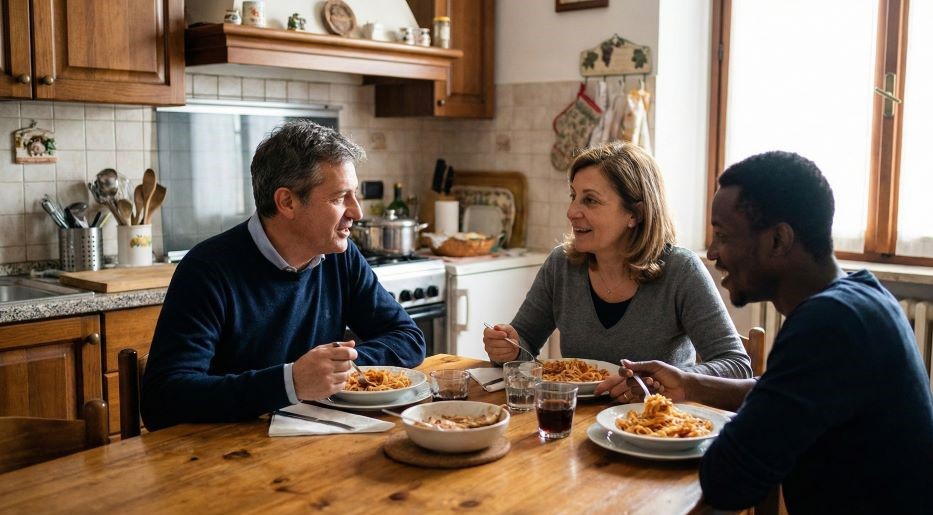
How to make sure you speak Italian in a homestay
You can end up speaking English, and it usually happens for one reason: it’s quicker. When you’re tired after classes, English is the easy switch. The fix is not to be too strict: it’s to agree on a few simple habits from the beginning.
For example: Italian during dinner, Italian for daily plans, and English only if it’s genuinely necessary. A good host won’t mind you searching for words. They will help you, gently. And in addition, you’ll pick up the Italian you don’t learn from books: tone, politeness, the little phrases Italians use around the table every day.
Renting an apartment in Italy: freedom, comfort, and the isolation risk
Renting an apartment can be a great option, if you make it social. An apartment gives you freedom (you choose your routine, your food, your evenings, your friends). If you’re living in the city center, you’re close to cafés, events, and that spontaneous aperitivo that turns into Italian conversation without you even trying.
Isolation sets in when your Italian life consists only of morning classes, followed by going home and seeing no one else. If you choose an apartment, you need a plan: regular activities, speaking practice, and real contact with Italians.
Wi-Fi and historic buildings
If you choose an apartment in a charming city center, remember that one-meter-thick stone walls are the natural enemy of Wi-Fi. In a homestay, hosts have usually already figured out the “dead zones”, but in a private rental, you might discover the signal doesn’t reach your bedroom or drops out during a storm.
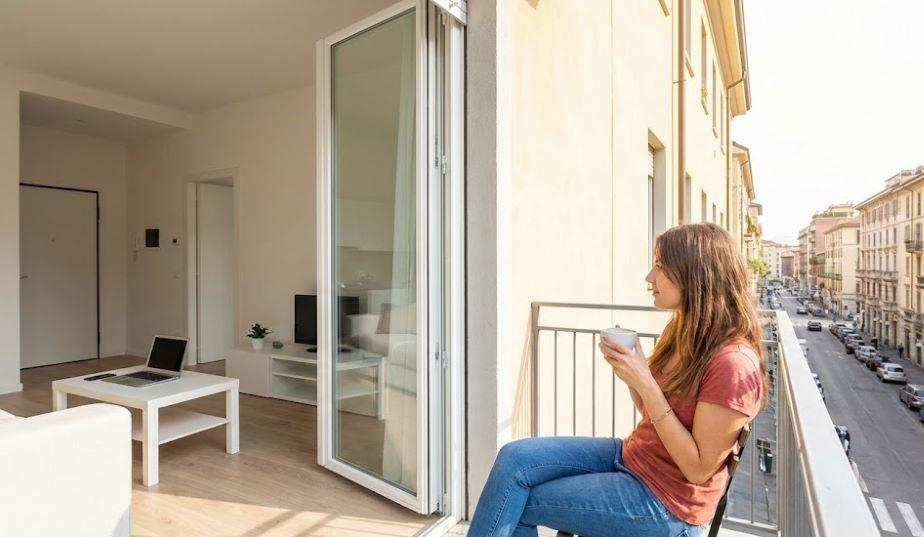
Living alone vs sharing: how your apartment choice affects your Italian
If language is the priority, sharing usually wins, especially if your flatmates are Italian or at least committed to speaking Italian at home. Living alone is brilliant for resting and privacy, but you’ll have to create your speaking time elsewhere every single day.
Shared apartments can also backfire if you live with international students. So the question isn’t just “alone or shared?”, it’s who you share with, and what language you actually use in the kitchen at 8pm when you’re hungry and tired.
Staying with a host family (homestay)
The linguistic “safety net” for those who want to speak from day one.
The pros
- “Automatic” conversation: you don’t have to force yourself to go out; Italian knocks on your door at breakfast and dinner.
- Zero admin stress: it’s all-inclusive.
- Real culture: you learn the gestures, the tone of voice, and how to actually cook pasta (and no, you don’t put ketchup on it!).
- Safety net: you have a local point of contact if you need a doctor, a pharmacy, or help navigating a strike.
The cons
- Shared space: you have to respect someone else’s habits (bathroom schedules, noise levels).
- Social fatigue: if you’re an introvert, having to “chat” after 4 hours of intensive classes can be draining.
- The comfort trap: you might be less likely to explore the city if you have a home-cooked meal waiting for you every night.
Renting an apartment (private or shared)
The choice for those ready to build their own “Italian life” from scratch.
The pros
- Total freedom: you decide who to invite over, what to eat, and when to come home.
- Targeted socializing: you can choose Italian flatmates to force yourself to speak, or host aperitivos for your school friends.
- Focus & work: if you’re a digital nomad or need absolute silence to prep for a CILS/CELI exam, a private apartment is unbeatable.
The cons
- The “English bubble”: if you don’t make an effort, you’ll end up speaking English with friends and only using Italian at school.
- Solo routine: without shared meals or household rituals, it’s easy to be more isolated and have limited local interaction.
- Less built-in Italian: the language doesn’t come to you automatically; you have to actively seek it out, instead of absorbing it through everyday, low-effort interactions at home.
Direct comparison: which fits you?
| Feature | 🏠 Homestay | 🔑 Apartment |
| Linguistic Effort | Passive (it surrounds you) | Active (you must seek it) |
| Privacy | ⭐⭐ (Moderate) | ⭐⭐⭐⭐⭐ (High) |
| Local Integration | Immediate (via family) | Gradual (via neighborhood) |
| Best for… | Short stays (2-4 weeks) | Long stays (1-3+ months) |
Expert tip: if you’re a beginner, living with a family gives you a strong foundation and the confidence to use what you’re learning. Once you can order at a restaurant and complain about a late train without breaking a sweat, you’re ready for the independence of an apartment.
Best choice for complete beginners: the fastest way to get speaking
If you’re a complete beginner and want to make fast progress, a homestay is usually the safest choice. You’ll hear Italian constantly, and even when you understand only 20%, your ears start adjusting. You’ll also practise simple, high-frequency language every day… greetings, requests, food, time, plans.
If you go for an apartment as a beginner, it can work, but only if you pair it with a strong language school routine: daily language courses, regular speaking activities, and a social plan that puts you in Italian situations on purpose.
Best choice for intermediate and advanced learners: autonomy vs immersion
At intermediate and advanced levels, both options can work well… you’re less afraid to speak, and you can handle real-life conversation. Ath this stage, many learners prefer an apartment (often shared) because they want more independence and more variety in who they interact with: classmates, neighbours, people they meet at aperitivo, etc.
That said, a homestay can still be powerful if you want to refine natural speech, humour, and family-style conversation — the stuff that’s usually harder to learn in a classroom.

Shy or introverted learners: choosing the right set-up for your personality
If you’re shy, a homestay can actually be easier because conversation happens naturally, in small doses. You don’t have to “go out and network” every day to hear Italian — it comes with dinner. With the right host, it’s calm, kind, and predictable.
If you’re introverted and you know you need silence to recharge, an apartment might be better — as long as you still commit to speaking practice outside. You can absolutely be introverted and make progress; you just need a routine that fits who you are.
Privacy and personal space: when a homestay still works (and when it doesn’t)
A homestay can work if you choose the right set-up: private room, clear boundaries, and a host who understands you’re there to study. Privacy doesn’t mean “no talking”; it means you have space when you need it.
If privacy is non-negotiable — your own kitchen, your own living room, your own schedule — an apartment is the easiest solution. Just remember: privacy is lovely, but language growth needs contact. You can have both, but you have to plan for it.
The smart combo strategy: homestay first, apartment later
If you’re staying for a longer period, starting your Italian experience in a homestay gives you a soft landing and built-in daily Italian practice at home. Then the apartment phase pushes you into a wider world: new friends, new routines, more independence, more situations where you can test what you’ve learned.
It’s also a very realistic rhythm for students taking Italian language courses: start with a support, then level up. Think of it as building confidence first, then building range.
Final decision checklist: how to choose your accommodation in Italy
Run through these four questions to see which path fits your current energy and goals:
1.The conversation gap: where will my Italian come from after 2:00 PM?
- Homestay: it’s served with dinner.
- Apartment: you have to go out and “hunt” for it at the local bar or supermarket.
2.The energy meter: am I an introvert who needs silence to recharge?
- If yes, an apartment is your safe haven.
- If no, a homestay provides the social “push” you might need.
3.The commute vs. comfort: is the apartment in the city center, or is it a 40-minute bus ride away?
- Don’t let a long commute drain the energy you need for studying. If the family is closer to the school, take the family!
4.The roommate reality: if sharing an apartment, what is the “house language”?
- If you’re living with three Americans, you aren’t learning Italian; you’re just living in a more expensive version of your hometown.
The pro tip: don’t forget the exam factor
If you are planning to take an official exam (like CILS or CELI), your environment matters more than ever.
- Ask the school: “Is this room quiet enough for intensive study?”
- Location matters: being within walking distance of the examination center saves you from “transit stress” on the morning of your big test.
The verdict
- Choose a homestay if: you are a beginner, staying for less than a month, or want to experience “the real Italy” without the stress of managing a household.
- Choose an apartment if: you are intermediate/advanced, staying for 3+ months, or need total control over your schedule and kitchen.
FAQs
Is a homestay in Italy worth it for learning Italian?
Usually yes — it builds daily “micro-practice” (meals, greetings, errands). It works best with clear house language rules.
Do people actually speak Italian in homestays, or do they switch to English?
Both happen. English creeps in when you’re tired — set expectations early (Italian at meals is a great start).
Is an apartment better for learning Italian?
It can be — but only if you build your own Italian routine outside the flat.
Should I live alone or share an apartment to practise Italian?
Sharing tends to be more helpful, especially with Italian flatmates. Alone is fine if you’re disciplined about speaking daily elsewhere.
Will I feel lonely in an apartment in Italy?
Sometimes, especially at the beginning. A course, clubs, sport, volunteering, and regular café routines make a huge difference.
Which option is cheaper: a homestay or an apartment?
It depends. Homestays bundle costs; apartments often add deposits, bills, and set-up fees.
What’s best for beginners?
Homestay tends to be the easiest start. If you choose an apartment, pair it with strong daily classes and speaking practice.
What’s best for intermediate/advanced learners?
Both work. Many prefer an apartment for independence, but homestays can be brilliant for natural conversation and fluency.
Your next step: learn Italian with the right support
There isn’t one perfect answer but there is a perfect match for you. If you want quick confidence and daily practice built into your routine, start with a homestay. If you want independence and you’re ready to intentionally build your Italian life, an apartment (ideally shared) can be a great choice. In both cases, the biggest accelerator is consistent, high-quality insegnamento: good teachers, the right course, and a school that keeps you speaking, not just studying.
If you’re ready to make real progress, have a look at the Italian language courses at IH Team Lingue — from beginner-friendly courses to exam-focused pathways, with proper support from the school and the people who do this every day.